The Illusion of ATV Safety: A Five-Part Investigation
Five systems. One question. Why do so many children continue to die on ATVs?
Over the next several weeks, I'll examine five interconnected systems that have contributed to decades of preventable child injuries and deaths: ATV design, federal regulation, industry standards, congressional oversight, and state legislation.
Each article highlights one piece of the evidence presented in my new book, The Illusion of ATV Safety, where I examine the full story behind America's ongoing ATV-related child fatalities and the systemic failures that, in my view, have contributed to them.
Part 1 of 5: Inherent Design Flaws
Why Adult-Sized ATVs Are Dangerous for Kids
When a parent allows their child or teenager to ride an adult-sized all-terrain vehicle (ATV), they usually do so out of trust. They trust their child's maturity, coordination, judgment —or simply believe that a helmet and proper training will keep them safe.
Yet decades of injury data reveal a reality that neither helmets nor rider training can overcome: children are being placed on machines that were never designed for them. The American Academy of Pediatrics recommends that no child under 16 operate an ATV, and the overwhelming majority of pediatric ATV deaths and serious injuries involve adult-sized machines.
When a child climbs onto a full-sized ATV, they are not simply taking a risk—they are fighting against physics. Adult-sized ATVs have inherent design characteristics that make them fundamentally unsuited for children.
1. A High Center of Gravity and a Narrow Wheelbase
Unlike passenger vehicles, which are designed with a low center of gravity for stability, ATVs are built with high ground clearance to travel over rough terrain.
The design: A high center of gravity combined with a relatively narrow wheelbase.
The consequence: Increased susceptibility to side rollovers and rear overturns.
Why children are at greater risk: Safely operating an ATV requires constant "active riding"—shifting body weight to counterbalance the machine during turns, hills, and uneven terrain. Most children simply lack the body mass, strength, and leverage needed to control a tipping ATV.
2. Incompatible Weight Ratios: The Crush Hazard
A youth-sized ATV typically weighs between 100 and 150 pounds. Modern adult-sized ATVs often weigh 600 to 900 pounds.
When a child weighing 100 pounds loses control of an 800-pound machine, the vehicle doesn't simply skid—it can overturn.
The result is often a crush injury, one of the leading mechanisms of severe injury and death in pediatric ATV crashes. When hundreds of pounds of machinery roll onto a child's chest, abdomen, or legs, a helmet cannot prevent crushing injuries, asphyxiation, or severe internal trauma.
3. Speed Reduces a Child's Ability to React
Many adult ATVs are capable of speeds well over 55 miles per hour.
Children and young adolescents are still developing the judgment, visual processing, and reaction time needed to respond to rapidly changing off-road conditions. Even at speeds well below an ATV's maximum, avoiding rocks, ruts, steep slopes, or unexpected terrain changes often requires split-second decisions and precise body movements.
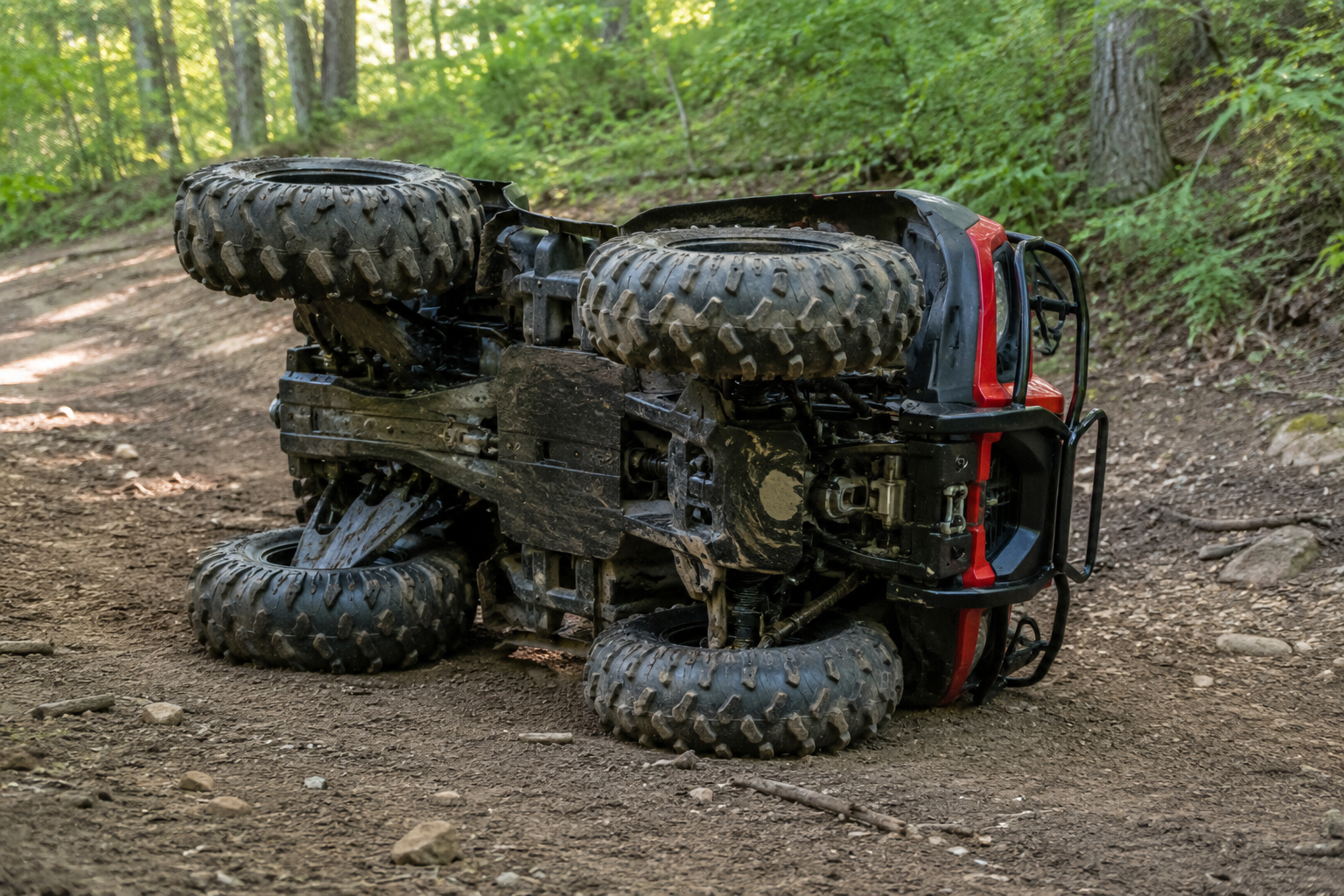
The reality of the safety Illusion. It’s not if, but when will the machine rollover and kill.
The Illusion of Safety
Many parents believe that if a child can reach the handlebars, operate the throttle, and wear a helmet, the vehicle is safe.
Unfortunately, mechanical reach does not equal mechanical control.
These tragedies are not simply the result of rider error. In my view, they are often the predictable outcome of placing children on machines whose design exceeds their physical and developmental capabilities.
Adult-sized ATVs are powerful machines whose design demands physical strength, body weight, and rapid decision-making that children simply have not yet developed. As a result; every year thousands of children under 16 are injured, and nearly 200 lose their lives.
Next in the series:Part 2 — The Consumer Product Safety Commission and ATV Safety: What the Data Reveals
In The Illusion of ATV Safety, I examine these design flaws in greater depth and explore the broader systemic failures that, in my view, have allowed preventable child injuries and deaths to continue for decades. Read the first two chapters free and see the evidence for yourself.