The Illusion of ATV Safety: A Five-Part Investigation
Five systems. One question. Why do so many children continue to die on ATVs?
This is Part 3 of a five-part series examining the evidence presented in my book, The Illusion of ATV Safety.
The Specialty Vehicle Institute of America and ATV Safety: When Warnings Replace Standards
The Industry's Safety Model: Why Warnings and Training Are Not Enough
While the CPSC provides federal oversight, the Specialty Vehicle Institute of America (SVIA) shapes ATV safety from within the industry. Formed by leading manufacturers—including Honda, Yamaha, Polaris, Kawasaki, and others—the SVIA develops voluntary safety standards and promotes rider education throughout the United States.
However, the industry does not issue these warnings purely out of goodwill. The SVIA is legally mandated by the CPSC to place strict age-recommendation warning labels on all ATVs, turning what the industry frames as corporate responsibility into a strict federal requirement. In my view, the industry's safety model is built on a fundamental contradiction. Although the SVIA acknowledges that children under 16 should never operate adult-sized ATVs, it continues to support a system that relies primarily on warnings and voluntary rider training rather than engineering changes or laws that could reduce risk.
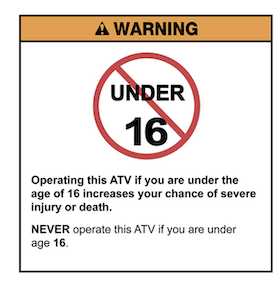
This CPSC-required warning tells consumers that children under 16 should never operate an adult-sized ATV. Yet the warning itself does not prohibit a child from operating one. That distinction is central to the question: When a warning replaces a requirement, is it really safety?
Responsibility Placed on Parents and Children
While the SVIA point to this tiny, federally mandated sticker as proof of their commitment to safety, their advocacy stops where real accountability begins. The industry is proud to display these warnings on the plastic fenders of their machines, yet when it comes to actively backing mandatory state laws to legally keep children off adult-sized ATVs, they are nowhere to be found. By heavily promoting "rider education" and warning labels, the responsibility is entirely shifted away from the manufacturer and onto the parents and children.
Looking Beyond Industry Standards
In The Illusion of ATV Safety, I describe the SVIA as the industry's "two-headed monster." The term reflects what I believe is an inherent conflict of interest that has shaped ATV safety for decades. I examine how one organization came to play two influential roles—and why that matters for the safety of children.
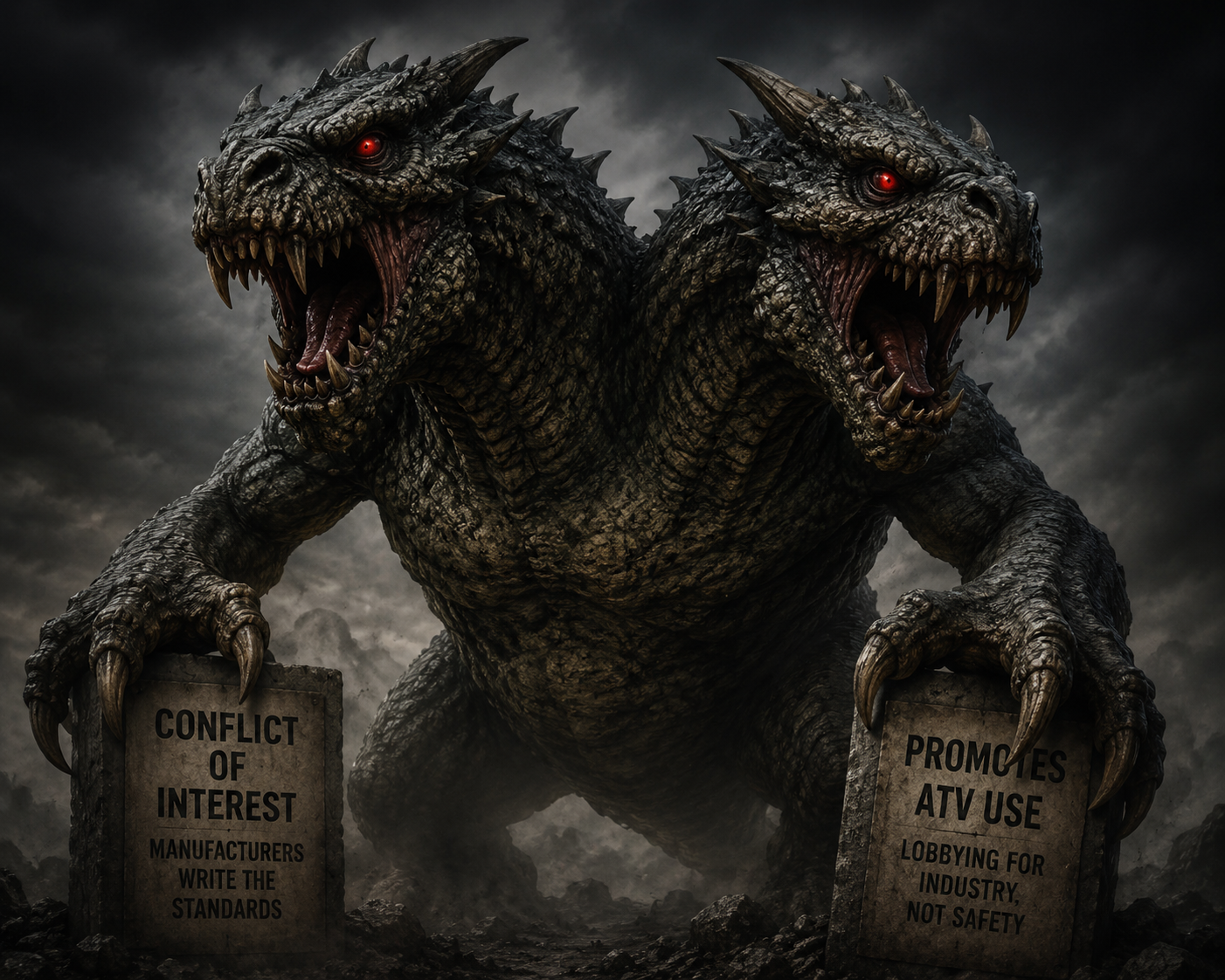
Insufficient facts always invites danger. Time for the truth to be told.
Start with free chapters from the book The Illusion of ATV Safety
Next in the series: Part 4 — The Senate's Oversight Failure: Child ATV Safety on Capitol Hill