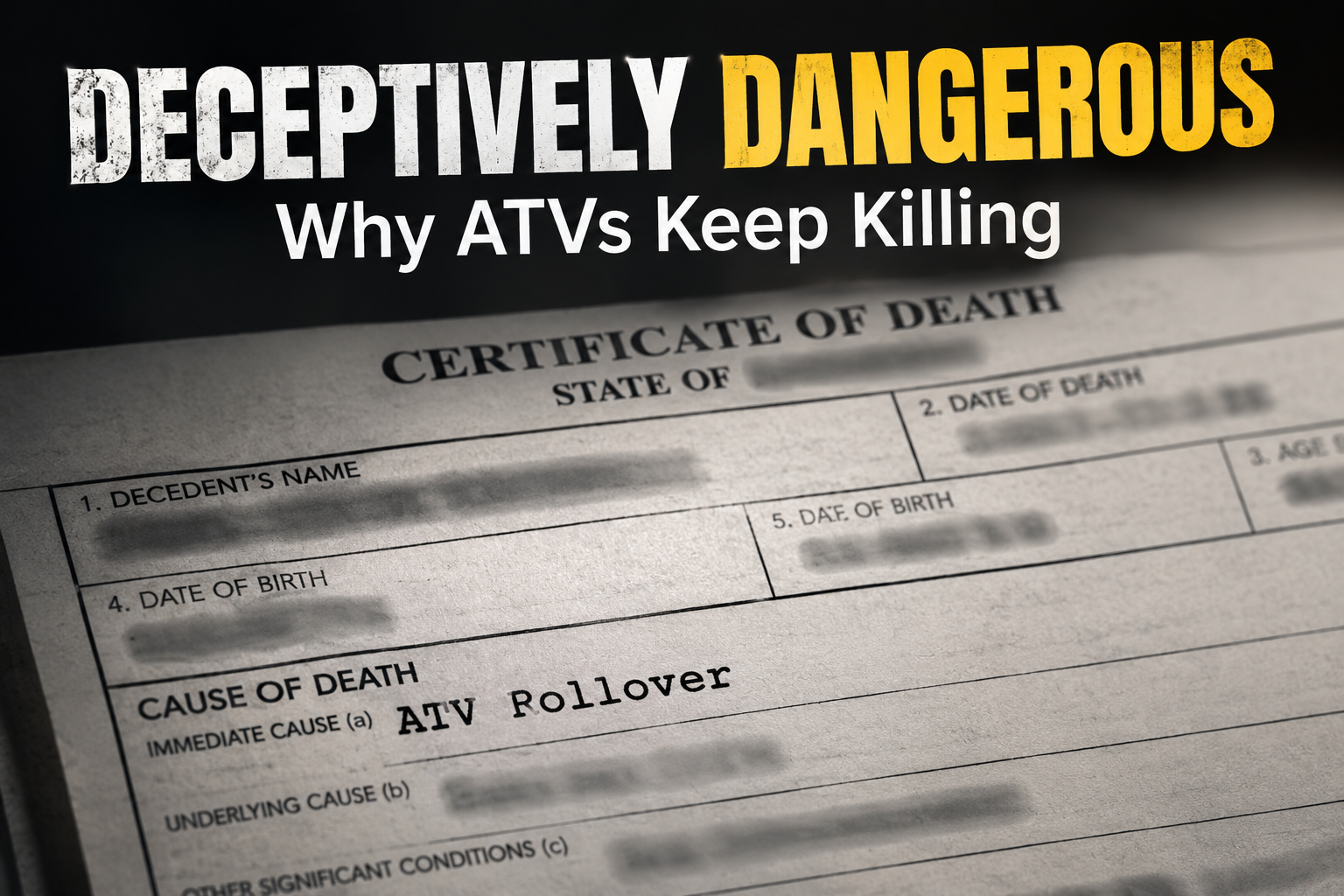
The "Safe Rider" Fallacy
The Oregonian analyzed thousands of fatal crash records from the Consumer Product Safety Commission (CPSC). They separated the data into two distinct groups: riders who violated at least one major safety warning (no helmet, riding on pavement, carrying a passenger, underage) and riders who followed every single rule perfectly.
The Result: The investigation found that riders who followed all safety warnings overturned in about two out of five crashes.
The Reality: This rollover rate was mathematically comparable to the group that ignored warnings. It proved that compliance with safety rules does not insulate a rider from the vehicle's underlying mechanical instability.
Independent Stability Testing
The Oregonian hired an independent engineering firm to physically test four of the most popular four-wheel ATV models on the market from major brands.
The engineers concluded that the vehicles were inherently prone to overturning.
Because of their narrow track width, high ground clearance, and solid rear axles, the vehicles possess a dynamic tendency to flip or trigger a "bucking bronco" effect at speeds and angles that a rider simply cannot physically react to or correct in time.
How the Industry Uses Labels to "Get Away With It"
The series heavily criticized how manufacturers shifted their legal liability. In the 1980s, the federal government labeled ATVs an "imminent risk" and forced the industry to stop selling three-wheelers. However, instead of mandating strict, safer geometry standards for four-wheelers, regulators settled for voluntary compliance.
The industry plastered vehicles with detailed warning labels. The Oregonian highlighted that these labels function primarily as a legal bulwark in court. When a rider is injured or killed, manufacturer lawyers point directly to the labels to convince juries that the incident was entirely due to user error, effectively shielding the brand from multi-million dollar design defect lawsuits.
The standard tells operators to use proper riding techniques to avoid overturns. But where is the prominent warning that explains the vehicle's own rollover risks?
This blog just scrapes the surface as to why so many children continue to get injured and killed on ATVs.
Read the Illusion of ATV Safety to see all the reasons and how you can help.